In this article
Before setting off, I needed to know the route was possible
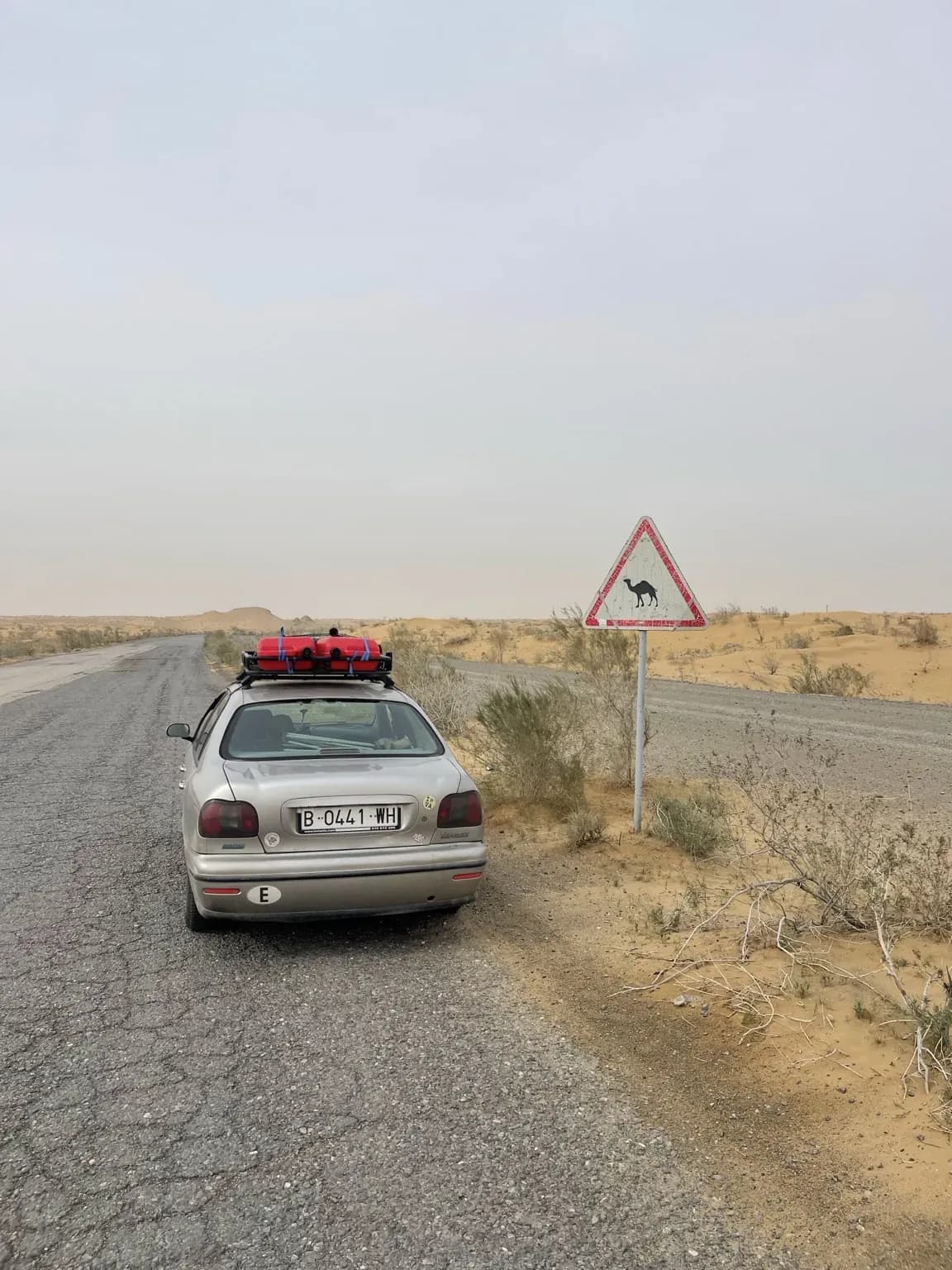
When I decided to drive the Marea around the world — or first get it to Japan — I started with a basic question: could a car actually make the whole journey? Before visas or wondering what a €900 Fiat could survive, I needed to rule out any gaps I could not get it across.
I could plot a route to Vladivostok on Russia’s Pacific coast. Japan, however, was on the other side of the sea. The Marea was not going to drive that last stretch.
The operator I found was DuWon Shipping, connecting Vladivostok with Donghae and Donghae with Sakaiminato. They told me restrictions linked to Russia’s war meant they could not arrange the direct entry into Japan I had proposed.
I had barely started planning and already had a fairly fundamental problem: I could cross a continent and still be stuck on the wrong side of the sea. The arrangement we settled on was Russia to South Korea, then South Korea to Japan, using separate bookings.
Later I learned that Adrià, @adrimp36 on Instagram, had reached Japan from Russia in his Honda S2000 without spending those weeks in Korea. My route was not necessarily the only possibility; it was the arrangement I obtained.
Here are the contacts, paperwork and figures I can trace back to my records. Other travellers’ accounts helped enormously when I was organising it. I hope mine makes someone else’s starting point less vague.
The contacts for each stage
Chloe coordinated the DuWon bookings, Yuri handled Russian clearance, and Mr Ryu at Sakaiminato advised me on the Japanese arrangements.
| Contact | Context |
|---|---|
| ymelnik@links-ltd.com | Yuri Melnikov at Links, Ltd., my Vladivostok customs agent in 2025. |
| booking@dwship.co.kr | DuWon’s general address, on my invoices and its current website. |
| sbson@dwship.co.kr | Chloe’s address in my 2025 correspondence. Her current role has not been confirmed. |
| otat@ecfjapan.com | The address DuWon gave me for Mr Ryu in 2025. |
| ecfjapan@ecfjapan.com | The Sakaiminato branch address currently published by DuWon. |
Vladivostok: handing over the car before sailing
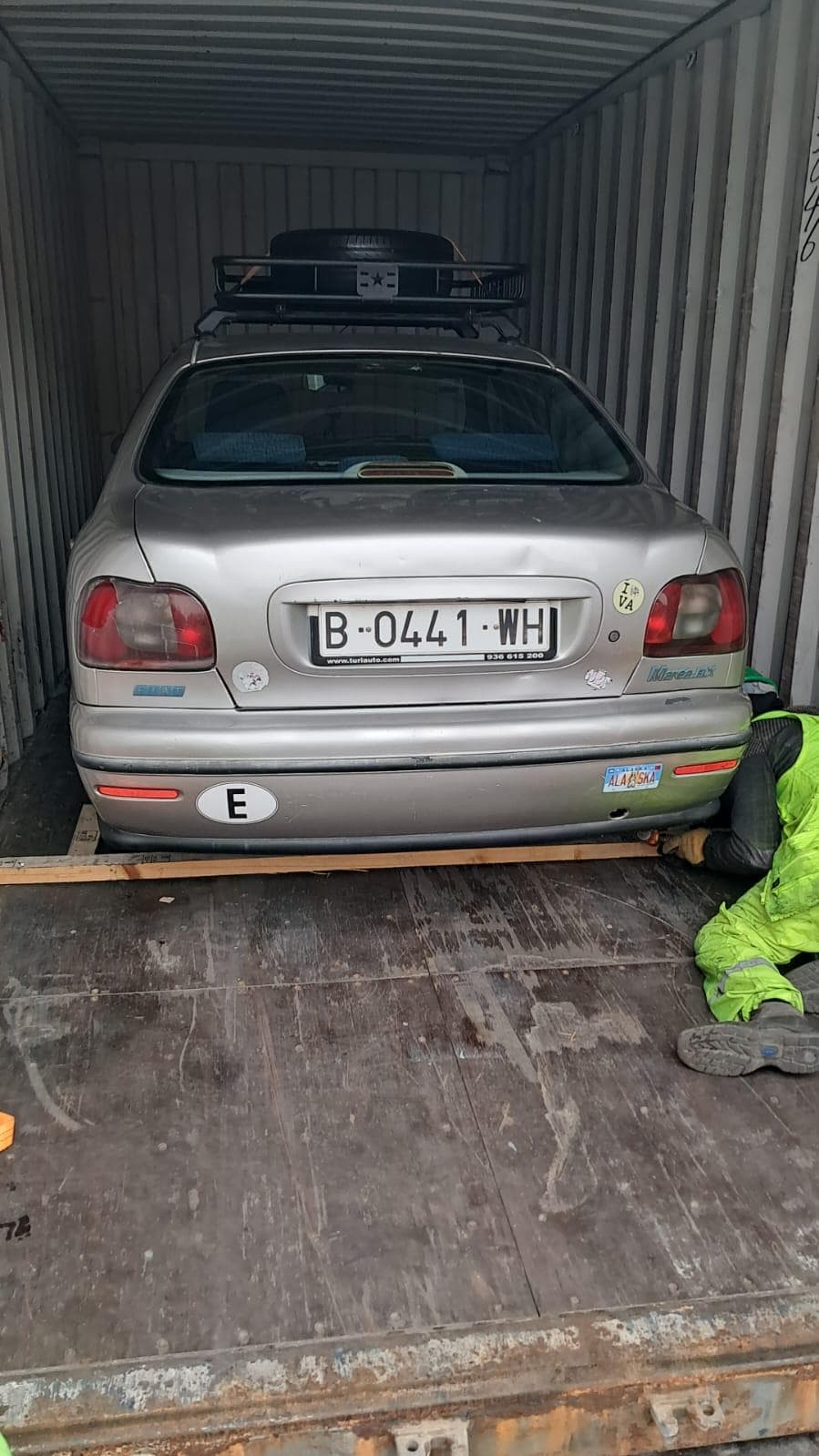
The sailing was on 14 May 2025, but the Marea had to be at the port on 11 May for clearance. I would not have access to it. When the car is also your bedroom, that means finding accommodation and taking out everything you will need beforehand.
Because my route included leaving Russia for Mongolia and entering again, Yuri needed the customs declaration and migration card from that final entry. On 13 May he sent the stamped export copy: getting the car out also meant closing its earlier temporary admission correctly.
Vladivostok and the first crossing
Swipe or use the arrows · Tap an image to enlarge it
1 / 8
All the paperwork I had to prepare
This involved more than emailing a passport and buying a ticket. For Russia and Korea I supplied my passport, Russian visa, migration card, registration papers, driving licence, international driving permit, temporary import declaration and photographs of the vehicle, plate and chassis number. Then came the forms.
| Document | What I was asked to provide |
|---|---|
| Letter of Promise · Korea | An undertaking to re-export within the permitted period without selling or transferring the car. DuWon acted as guarantor. |
| Temporary import application · Korea | Personal and vehicle details, stay, re-export deadline and insurance period, entered in the yellow fields. |
| Inventory with photographs | An itemised list of the contents, with quantities, values and photographs. “Luggage” was not enough detail. |
| C5014 · Japan | The vehicle’s temporary import/export declaration. |
| C5390 · Japan | An application for inspection outside the designated area. |
The inventory took work. DuWon reviewed it and asked me to remove food from the car, carry certain items as passenger luggage and not transport gas cartridges or flammable substances. Auxiliary fuel containers had to be empty. Even the coffee maker and food containers needed reorganising.
For Japan, they checked the inventory was unchanged and requested an outline itinerary, contact details and the length of my stay for insurance. I was told to complete two handwritten copies each of C5014 and C5390 and bring the originals for clearance.
I also sent my Carnet de Passages en Douane (CPD), stamped Russian export declaration and itinerary to the Japanese ministry. When leaving Korea I needed to retain the temporary declaration and yellow driving-permit sticker for Customs to collect.
The actual inventory I submitted
This is the final list I submitted: 30 entries, with photos of spare parts, tools, sleeping gear and even my shoes. Personal details and my signature have been removed. The full PDF has eight pages.
The actual inventory I submitted
1 / 2
See all five original blank forms
The five forms I was sent
Forms received in 2025 · Swipe or tap to enlarge
1 / 5
Russia to Korea: what the costs covered
The passenger invoice was reissued from won into US dollars. These are two versions of the same booking, not two purchases.
| Item | Amount | Evidence |
|---|---|---|
| Passenger fare and included charges | USD 324 | Invoice dated 22 April 2025 |
| Overseas remittance charge on that invoice | USD 60 | Passenger invoice total: USD 384 |
| Vehicle: freight 700 + documents 30 + guarantee 100 + handling 200 + remittance 60 | USD 1,090 | 8 May invoice; payment confirmed by DuWon |
| Donghae: stevedoring 73,200 + wharfage 3,000 + 15-day insurance 195,000 | KRW 271,200 | Invoice for cash payment on 15 May |
| Russian agent’s fee | USD 150 | Quoted by Yuri by email |
| Russian local clearance charge and port costs | RUB 3,000 + 57,000 | Confirmed quotation from Yuri, separate from the ferry |
The two dollar-denominated DuWon invoices total USD 1,474. Separate from that were KRW 271,200 in Korean arrival charges and the Russian quotation of USD 150 plus RUB 60,000. I have not turned these into a supposedly exact euro total.
I was told to bring the Donghae charges in cash and warned that there was no cash machine inside the port. I confirmed I would have KRW 300,000 ready to cover the quoted KRW 271,200.
The invoices, with private details removed
Swipe or use the arrows · Tap an image to enlarge it
1 / 3
Korea: the easiest place I have travelled with the car as my bedroom
I am very glad I made that stop. South Korea became one of my favourite countries of the journey. I spent around two weeks exploring it, trying to stick to ordinary roads rather than motorways.
I also discovered something that suited me perfectly: car camping is a familiar pastime there, with its own name, chabak (차박). Of all the countries I have visited, it is where I have felt most comfortable sleeping in the car.
And the local setups were on another level. People opened the boot and seemed to unfold an entire living room: tables, chairs, everything neatly arranged, then an impressive meal. I had the Marea and my assorted belongings; they had a pop-up home. Seeing it treated as such a normal way to spend time was one of the things I loved about Korea.
Two weeks in Korea
Swipe or use the arrows · Tap an image to enlarge it
1 / 4
Entering Japan after travelling through Russia
The second booking was Donghae to Sakaiminato, leaving on 29 May and due in on 30 May. Stopping in Korea did not erase the car’s history: DuWon told me to raise the case with Japan’s Ministry of Economy, Trade and Industry, or METI.
I contacted bzl-russia-seisai@meti.go.jp with the inventory, Russian declaration, CPD and itinerary. The 28 May reply explained restrictions on certain goods shipped from Russia and a possible exception for the personal effects of temporary visitors, referring me to Japan Customs for clearance. It was not automatic permission or a statement I can assume applies today.
I also needed to visit Spain while leaving the Marea in Japan. The office told me to discuss an authorisation connected with the carnet through JAF. Holding a CPD did not mean I could simply leave the car behind and fly out.
The Korea–Japan return booking: my invoices
On 22 May I received two invoices to pay separately. DuWon confirmed receipt of payment on 23 May.
| Documented charge | Amount |
|---|---|
| Round-trip passenger and vehicle booking package, as invoiced | KRW 900,000 |
| Carrier’s overseas remittance charge | KRW 30,000 |
| Separate invoice for documentation, stevedoring and wharfage across both legs | KRW 192,400 |
| Combined invoice total | KRW 1,122,400 |
The KRW 192,400 consisted of documentation —40,000— plus stevedoring —73,200 each way— and wharfage —3,000 each way. KRW 1,122,400 was the invoice total for a return booking, not a one-way crossing.
Separately, the Japanese office estimated JPY 11,900: terminal handling 2,500, documents 4,400 and customs attendance 5,000, plus insurance at actual cost. That was an emailed estimate, not a receipt. Additional banking fees are not included in the invoice total either.
The invoices, with private details removed
Swipe or use the arrows · Tap an image to enlarge it
1 / 2
Arriving in Japan — and the return-ticket condition
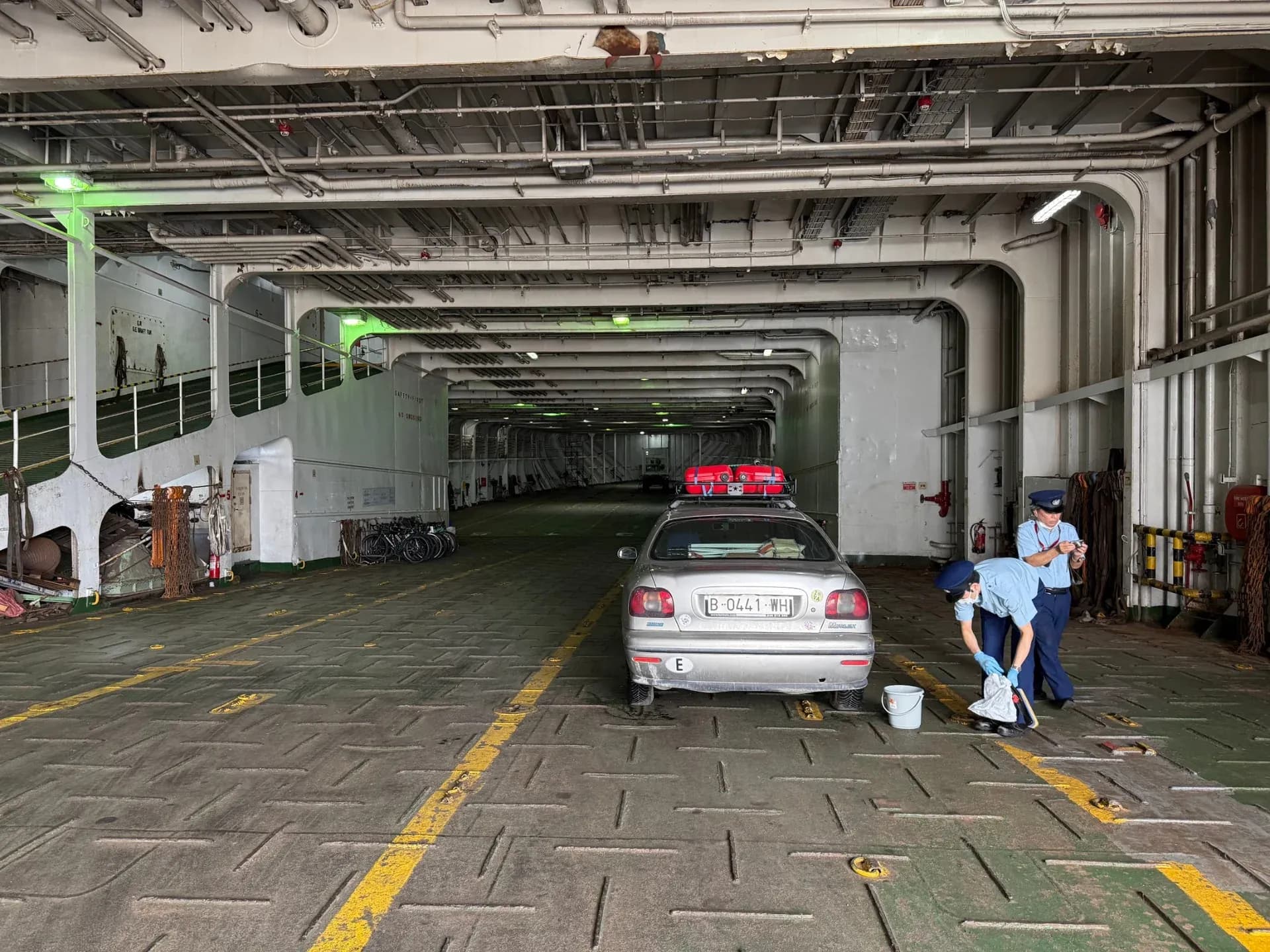
At Sakaiminato the car had to go through the customs-controlled area while I dealt with entry, insurance and local payments. Release depended on clearance. As the cover photograph shows, two customs staff even came over with a cloth to disinfect the Marea’s tyres.
Arriving in Japan with the Marea
Swipe or use the arrows · Tap an image to enlarge it
1 / 5
The booking included a return to Donghae, initially dated 28 June and later moved to 5 July. When I began organising the car’s onward shipment towards America through another Japanese port, I asked about a refund.
On 1 July DuWon replied that unused passenger and vehicle fares were non-refundable under my booking’s conditions. If you intend to continue to another country, get that point settled before paying.
What I would confirm before booking
- Acceptance of my vehicle, registration and full itinerary, including Russia.
- The documents, insurance and authentication required for my circumstances.
- A breakdown of passage, vehicle transport, agent and port charges.
- What happens if I do not return to Korea or leave Japan through another port.
DuWon currently directs temporary vehicle import/export bookings through its staff rather than the online booking system. I would start there and request instructions specific to my car.
Frequently asked questions
Is a two-week stop in Korea compulsory?
I am not saying it is. That was my itinerary and it became a highlight of the trip. Adrià made different arrangements; confirm the options for your own vehicle with the carrier and authorities.
Does the ferry ticket cover everything?
Not in my case. There were separate vehicle, Russian agent and port charges, Korean arrival costs and insurance, and Japanese local procedures. That is why the invoices are grouped by crossing.
Can I use these forms for a future trip?
They show what I was sent. Obtain the current forms and instructions from the office that will handle your vehicle.